

Powered To Heal: How PEMF Supports Healing, Comfort, and Performance
When most people think about healing, they think about medications, surgery, or physical rehabilitation. But every heartbeat, every nerve impulse, every muscle contraction, and every healing tissue in the body depends on something even more fundamental—electricity.
The body is an electrical system.
Every cell communicates using tiny electrical signals, and maintaining those signals is essential for normal function and repair. This is where Pulsed Electromagnetic Field (PEMF) therapy, including devices MagnaWave®, has become an exciting tool in both human and veterinary medicine.
At Fauna Doc Integrative Veterinary Services, we use MagnaWave PEMF as part of a comprehensive, evidence-informed treatment plan to help horses, dogs, and cats recover from injury, manage chronic pain, improve mobility, and support overall wellness.
Your Animal Is an Electrical Being
Every cell in the body maintains a tiny electrical charge across its membrane. This electrical gradient is critical for life. It allows cells to produce energy, transport nutrients, remove waste products, communicate with neighboring cells, and repair damaged tissue.
Your pet's heart beats because of electrical impulses. Muscles contract because of electrical signals. The brain and nervous system communicate through electrical activity.
When tissues become injured or chronically inflamed, these normal electrical processes become less efficient. Cells may struggle to produce energy, inflammation persists, circulation slows, and healing can take longer than expected.
Rather than forcing the body to heal, PEMF therapy helps optimize the cellular environment so the body's own repair mechanisms can function more efficiently.
A Brief History of PEMF Therapy
The concept of using electromagnetic fields to promote healing is not new. Scientists have long recognized that the body is fundamentally electrical. This understanding led researchers in the 1960s and 1970s to investigate whether carefully controlled pulsed electromagnetic fields (PEMF) could stimulate tissue repair and improve bone healing. Their work eventually resulted in FDA-approved PEMF devices for the treatment of certain non-union fractures in human medicine and laid the foundation for decades of research into bioelectrical medicine.
As space exploration advanced, NASA encountered a unique physiological challenge. In the microgravity environment of space, astronauts experience rapid bone density loss, muscle atrophy, and changes in cellular function despite spending hours each day exercising. Long-duration missions can result in bone loss of approximately 1–1.5% per month, making the prevention of musculoskeletal degeneration a critical priority for future space travel.
In the early 2000s, NASA funded a multi-year research program led by physicist and biomedical engineer Dr. Robert Dennis to investigate whether precisely designed pulsed electromagnetic fields could stimulate mammalian tissue regeneration and help counter some of the biological effects of microgravity. During this work, Dr. Dennis developed specialized electromagnetic waveforms characterized by extremely rapid slew rates—the speed at which the magnetic field rises and falls during each pulse. His research demonstrated that the waveform itself—not simply the strength of the magnetic field—plays a critical role in how living tissues respond to PEMF stimulation.
NASA's tissue engineering research went on to demonstrate that carefully designed electromagnetic fields could influence cellular signaling, gene expression, cartilage metabolism, bone remodeling, and tissue repair. These findings helped expand our understanding of how electromagnetic energy interacts with living tissues and highlighted the importance of factors such as frequency, waveform, pulse duration, magnetic field strength, and slew rate in producing specific biological effects.
Although exercise remains NASA's primary strategy for maintaining astronaut bone and muscle health, this pioneering research significantly advanced the science of bioelectrical medicine and contributed to the development of many modern PEMF technologies used today.
Today, PEMF therapy is widely used throughout human and veterinary rehabilitation as a safe, non-invasive modality to support healing, reduce pain and inflammation, improve circulation, and enhance recovery from orthopedic and soft tissue injuries.
One of the most important lessons from decades of PEMF research is that not all PEMF systems are created equal. The biological response depends not only on the intensity of the magnetic field but also on how that energy is delivered. Differences in waveform, frequency, pulse duration, and slew rate can all influence how cells respond to treatment. This is one of the reasons why different PEMF devices may produce different clinical effects and why treatment protocols should always be tailored to the individual patient
Our Electrical Environment
Life on Earth has evolved within a naturally occurring electromagnetic environment. One of the best-known examples is the Schumann Resonance—a series of extremely low-frequency electromagnetic waves generated by lightning activity between the Earth's surface and the ionosphere. The fundamental frequency averages approximately 7.83 Hz.
Researchers have long been fascinated by these naturally occurring frequencies because many biological processes—including certain brain wave patterns and cellular electrical activity—also occur within low-frequency ranges. Scientists continue to investigate how these natural electromagnetic fields play subtle roles in regulating physiology, sleep, stress responses, and overall health.
At the same time, modern life has dramatically changed our electromagnetic environment. Homes, offices, electrical wiring, wireless technology, and electronic devices all generate their own electromagnetic fields. Some researchers have questioned whether spending less time in direct contact with the Earth's surface may influence human and animal physiology.
This growing interest has also led to research on grounding, or earthing—the practice of walking barefoot on natural surfaces such as grass, soil, or sand. Some studies suggest grounding may influence inflammation, sleep quality, stress physiology, and autonomic nervous system function, although larger, high-quality studies are still needed before firm conclusions can be drawn.
Regardless of the underlying mechanism, spending time outdoors, encouraging natural movement, and allowing animals to interact with their environment remain important components of overall health and well-being.
It is important to understand, however, that PEMF therapy is not simply "replacing" the Earth's natural electromagnetic fields. MagnaWave delivers carefully controlled pulsed electromagnetic fields with specific frequencies and intensities designed to interact with living tissues in ways that support normal cellular function.
The Biology of PEMF: How Electromagnetic Energy Influences Cellular Healing
At its core, healing is a cellular process. Whether repairing a tendon, reducing inflammation within an arthritic joint, or recovering from surgery, every tissue depends on billions of individual cells responding appropriately to injury.
For those cells to function normally, they require three fundamental things:
Efficient communication with neighboring cells
Adequate energy production (ATP)
The ability to transport nutrients into the cell while removing waste products
PEMF therapy influences all three.
Cell Membrane Potential: Restoring the Cell's "Battery"
Every living cell maintains an electrical gradient across its membrane known as the transmembrane potential or resting membrane potential. This voltage difference is created by sodium, potassium, calcium, and chloride ions moving through specialized ion channels.
Think of the cell membrane as a rechargeable battery.
Healthy cells maintain a strong electrical potential that powers nutrient transport, protein synthesis, waste removal, and cellular communication. When tissue becomes injured or chronically inflamed, that membrane potential often decreases. The cell essentially becomes "energy deficient," making it less efficient at carrying out normal repair processes.
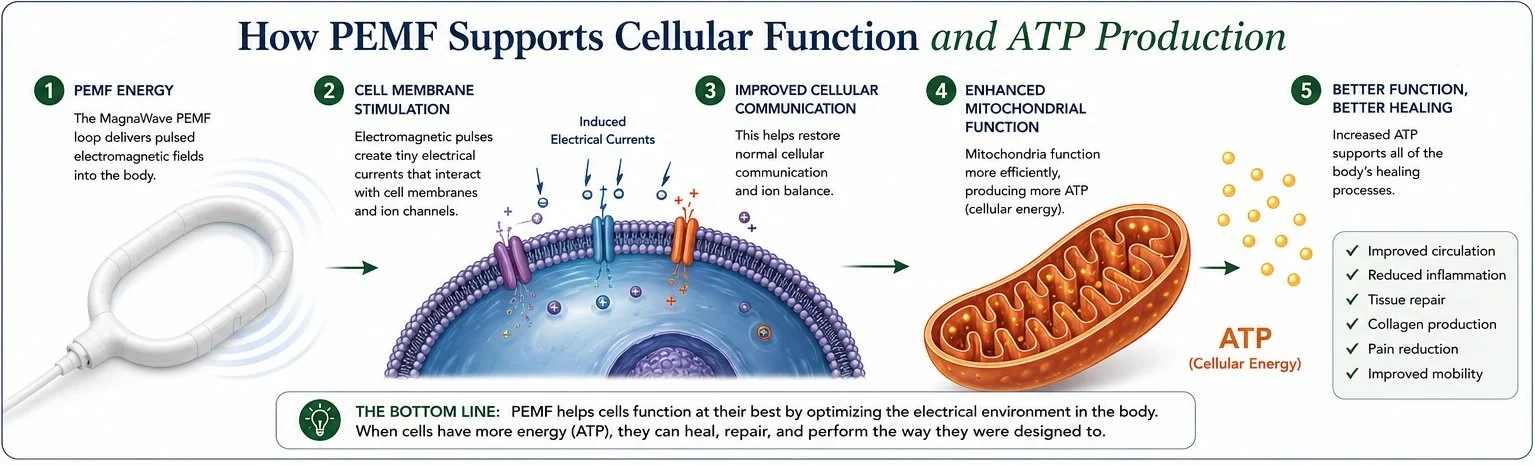
PEMF delivers rapidly changing magnetic fields that induce extremely small electrical currents within tissues through a principle known as Faraday's Law of Electromagnetic Induction. These induced currents are believed to influence voltage-gated ion channels and help normalize membrane polarization, improving the cell's ability to communicate and function.
Rather than forcing a cell to heal, PEMF helps restore the electrical conditions necessary for normal cellular physiology.
Mitochondria: Fueling the Cell's Powerhouses
Once membrane function improves, mitochondria—the energy-producing organelles within the cell—can operate more efficiently.
Mitochondria generate adenosine triphosphate (ATP) through oxidative phosphorylation via the Krebs cycle. ATP serves as the universal energy currency for nearly every biological process, including:
Protein synthesis
Cell division
Collagen production
Active transport of nutrients
Muscle contraction
Nerve conduction
Tissue repair
Several experimental studies suggest PEMF enhances mitochondrial respiration, leading to increased ATP production. More available ATP means cells have greater energy reserves to support healing and maintain normal physiological function.
Calcium Signaling and Cellular Communication
One of the earliest biological responses to PEMF appears to involve changes in calcium ion flux.
Calcium acts as an intracellular messenger, regulating hundreds of biological pathways involved in inflammation, muscle contraction, enzyme activation, and gene expression.
PEMF has been shown to influence voltage-gated calcium channels, allowing calcium concentrations inside the cell to change in a controlled manner. These calcium signals activate numerous downstream pathways responsible for tissue repair and regeneration.
In many ways, calcium functions like a molecular "switchboard," coordinating how cells respond to injury.
Nitric Oxide and Improved Circulation
PEMF has also been shown to stimulate production of nitric oxide (NO).
Nitric oxide is a naturally occurring signaling molecule that causes blood vessels to relax through vasodilation, improving local circulation.
Better circulation allows injured tissues to receive:
More oxygen
More nutrients
Greater delivery of immune cells
Improved removal of inflammatory byproducts and metabolic waste
Improved microcirculation is thought to be one of the major reasons animals often demonstrate reduced soreness and improved mobility following treatment.
Modulating Inflammation Instead of Eliminating It
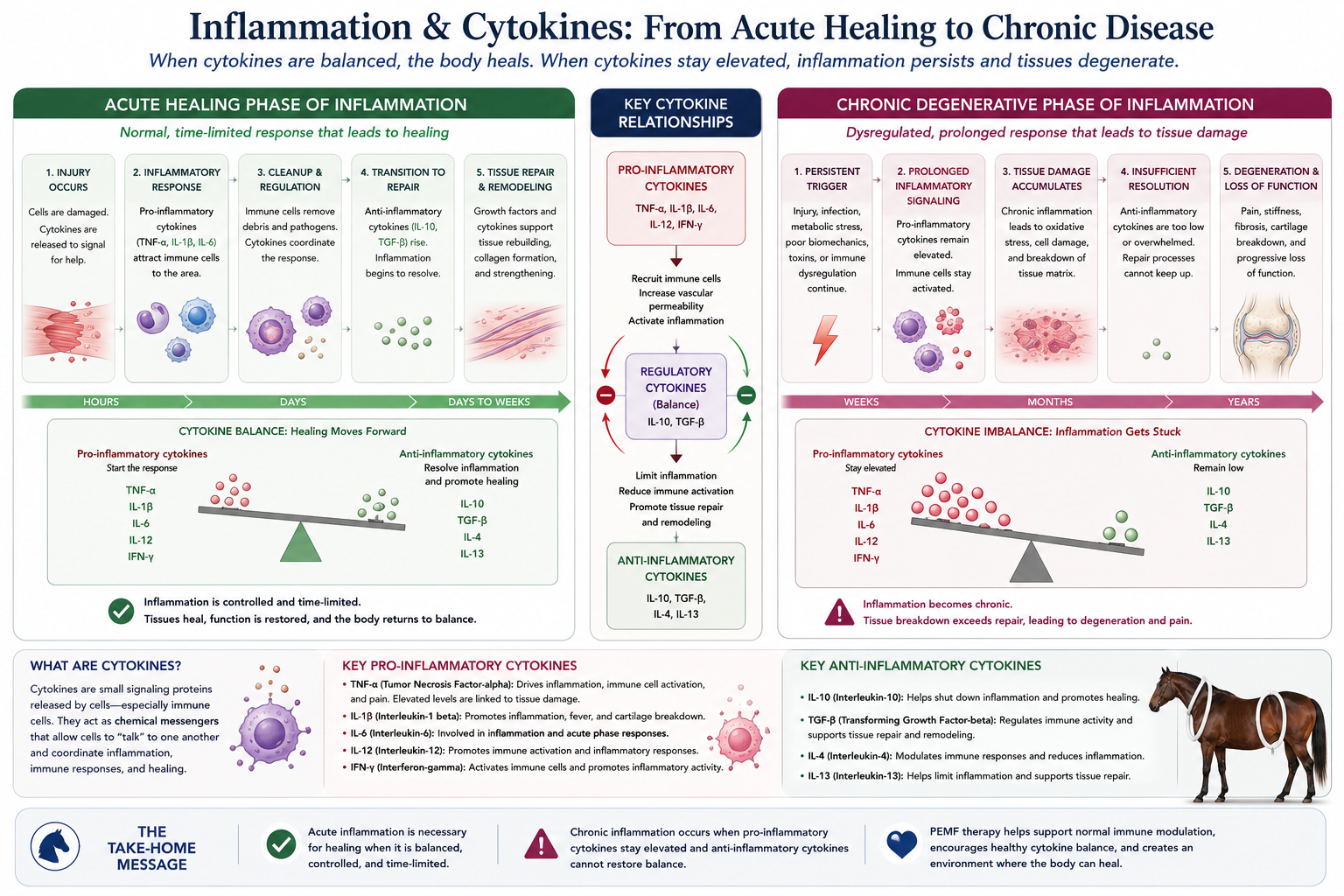
Inflammation is often viewed as something to suppress, but inflammation is actually an essential part of healing.
The problem occurs when inflammation becomes excessive or chronic.
Research suggests PEMF may help regulate inflammatory pathways by influencing cytokine production. Cytokines are small signaling proteins that act as chemical messengers between cells, helping coordinate the body's immune response, inflammation, and healing. Studies have demonstrated reductions in pro-inflammatory cytokines such as TNF-α, IL-1β, and IL-6, while supporting anti-inflammatory molecules.
Rather than shutting inflammation off completely, PEMF appears to help the body transition from prolonged inflammation into the tissue repair phase.
This distinction is important because successful healing requires appropriately regulated inflammation, not simply the absence of inflammation.
Supporting Tissue Remodeling
As healing progresses, tissues enter the remodeling phase.
Fibroblasts begin producing collagen, new blood vessels develop through angiogenesis, and damaged extracellular matrix is gradually replaced with organized tissue.
Experimental studies suggest PEMF may:
Stimulate fibroblast proliferation
Increase collagen synthesis
Promote angiogenesis
Support osteoblast activity during bone remodeling
Improve tendon and ligament healing
Enhance cartilage metabolism
These biological effects make PEMF particularly attractive for treating orthopedic injuries commonly seen in both horses and companion animals.
Healing Is More Than One Cell
One of the fascinating aspects of PEMF therapy is that it does not target a single disease or tissue.
Instead, it influences fundamental biological processes shared by nearly every cell in the body.
Whether treating a tendon injury, osteoarthritis, muscle soreness, or post-operative recovery, the same cellular principles apply:
Healthy cells communicate efficiently.
Healthy cells produce adequate ATP.
Healthy cells regulate inflammation appropriately.
Healthy cells repair damaged tissue effectively.
PEMF supports these normal physiological processes, allowing the body to do what it was designed to do—heal itself.
Research suggests PEMF therapy can:
Improve microcirculation
Increase oxygen and nutrient delivery
Support lymphatic drainage
Improve cellular energy production (ATP)
Reduce inflammation
Promote collagen production
Support bone remodeling
Encourage tissue repair
Reduce pain
Improve muscle recovery
Rather than masking pain, PEMF creates an environment that allows tissues to heal more efficiently.
What Can PEMF Help Treat?
Because PEMF works at the cellular level, it can benefit many different conditions.
Horses
PEMF is commonly used for:
Muscle soreness
Back and neck pain
Sacroiliac dysfunction
Arthritis
Tendon injuries
Ligament injuries
Suspensory desmitis
Navicular disease
Hoof pain
Rehabilitation after injury
Recovery following competition
Senior horse mobility
Performance horse maintenance
Dogs and Cats
PEMF can be used in patients with:
Osteoarthritis
Hip dysplasia
Cranial cruciate ligament injuries
Luxating patella
Intervertebral disc disease (IVDD)
Degenerative joint disease
Chronic pain
Soft tissue injuries
Post-operative recovery
Neurologic rehabilitation
Senior pet mobility
Is PEMF Safe?
One of the greatest advantages of MagnaWave therapy is its excellent safety profile. Treatments are gentle, painless, and well tolerated by nearly every species.
However, there are situations where treatment should be avoided or modified.
Contraindications and Precautions
PEMF may not be appropriate for:
Pregnancy (avoid treatment over the uterus)
Active or uncontrolled bleeding
Implanted electronic devices such as pacemakers
Certain seizure disorders, depending on the individual patient
Acute infectious disease accompanied by high fever
Areas requiring stabilization immediately following certain fractures
Cancer is not an absolute contraindication, but treatment should always be individualized based on the patient's diagnosis, goals of care, and overall treatment plan. This is one reason veterinary evaluation is so important before beginning therapy.
Why Receiving PEMF From an Integrative Veterinarian Is Different
One of the wonderful aspects of MagnaWave therapy is that it has become available through many knowledgeable and experienced practitioners. Skilled MagnaWave providers have helped countless horses and pets feel more comfortable through regular wellness and maintenance treatments.
At Fauna Doc Integrative Veterinary Services, however, a PEMF appointment is designed to be more than simply applying the MagnaWave coil.
As a veterinarian with advanced training in integrative medicine, every new patient begins with a comprehensive evaluation to understand why your animal is uncomfortable—not simply where they are uncomfortable.
Each assessment includes evaluation of posture, movement, gait, musculoskeletal compensation patterns, neurologic function, previous injuries, medical history, and overall health. Pain often originates somewhere other than where it is felt, and identifying that primary source of dysfunction allows treatment to be more targeted and effective.
One of the greatest advantages of PEMF therapy is its versatility. Because it is gentle, non-invasive, and well tolerated, it integrates seamlessly with many other treatment modalities to support the body's natural healing processes. Because I am also trained in veterinary acupuncture, Veterinary Medical Manipulation (VMM), Class IV laser therapy, extracorporeal shockwave therapy, rehabilitation, nutrition, and Chinese herbal medicine, I can determine when PEMF is the most appropriate therapy, when another treatment may provide greater benefit, or when combining multiple therapies will achieve the best outcome.
Depending on your animal's needs, MagnaWave may be combined with:
Veterinary acupuncture
Veterinary Medical Manipulation (VMM)
Class IV laser therapy
Extracorporeal shockwave therapy
Rehabilitation and therapeutic exercise
Therapeutic kinesiology taping
Nutrition
Chinese herbal medicine
Conventional veterinary medicine and surgery
Maintenance PEMF Sessions
Every new patient begins with a comprehensive veterinary evaluation so I can understand the underlying cause of discomfort, assess your animal's overall health, and develop an individualized treatment plan. This initial visit establishes a valid veterinarian-client-patient relationship (VCPR) and provides the medical foundation for future care.
Once a VCPR has been established and your pet or horse has been thoroughly evaluated, maintenance PEMF sessions may be recommended for many patients. These appointments are ideal for animals that benefit from routine wellness care, management of chronic conditions such as arthritis or back pain, or ongoing support for performance and recovery.
During maintenance visits, I continue to monitor your animal's progress and adjust treatment recommendations as needed. Because I know your animal's history and previous response to therapy, these sessions can often focus primarily on PEMF while still providing the advantage of ongoing veterinary oversight. If I identify any new concerns during a maintenance visit, we can expand the evaluation or incorporate additional integrative therapies to ensure your animal continues to receive the most appropriate care.
The Fauna Doc Philosophy
At Fauna Doc Integrative Veterinary Services, we believe successful treatment begins with understanding the patient—not just the diagnosis.
By combining comprehensive veterinary evaluation with evidence-informed therapies such as MagnaWave, we can identify the underlying contributors to pain and dysfunction, support the body's natural healing processes, and develop individualized care plans that help animals move more comfortably, recover more completely, and enjoy the highest possible quality of life.
Whether your goal is helping a senior dog enjoy daily walks, supporting recovery after surgery, managing a chronic orthopedic condition, or keeping your equine athlete performing at their best, PEMF can be an important part of a thoughtful, whole-body approach to veterinary care.
