
Anhidrosis in Florida Horses: Understanding the Science & Integrative Approach to the "Non-Sweating Horse"
Every summer across Florida, horse owners begin noticing the same concerning signs.
A horse that worked comfortably through the spring suddenly seems reluctant to exercise. Recovery after a ride takes longer than expected. Breathing remains rapid long after work has stopped. Despite obvious heat stress, the horse's coat stays dry—or only small areas produce sweat.
Many owners assume their horse is simply out of shape or "doesn't tolerate the heat."
In reality, these horses may be suffering from anhidrosis, commonly known as non-sweating syndrome.
For horses living in Florida's hot and humid climate, anhidrosis is far more than an inconvenience. Horses rely on sweating as their primary method of dissipating body heat. When that system begins to fail, even routine exercise can become physically demanding. In severe cases, anhidrosis can progress to heat exhaustion or life-threatening heat stroke.
Although there is no single cure, many horses can be successfully managed through a comprehensive approach that combines conventional veterinary medicine, environmental management, nutritional support, acupuncture, and Chinese herbal medicine. Understanding how and why anhidrosis develops is the first step toward helping affected horses.
Why Horses Sweat
Horses are incredible athletes, but every muscle contraction generates heat. During exercise, an average horse produces tremendous amounts of internal heat that must be dissipated to maintain a safe body temperature.
Unlike dogs, which cool themselves primarily by panting, horses depend on evaporative cooling through sweat. Approximately two-thirds of the heat generated during exercise is removed through the evaporation of sweat.
As sweat evaporates from the skin, it carries heat away from the body, functioning much like the cooling system in a car.
Without adequate sweating, the horse has very few alternatives for cooling itself. Increased respiratory rate and increased blood flow to the skin help, but these mechanisms are far less efficient—especially in Florida's humid climate, where evaporation is already compromised.
The Pathophysiology of Anhidrosis: What Happens Inside the Body?
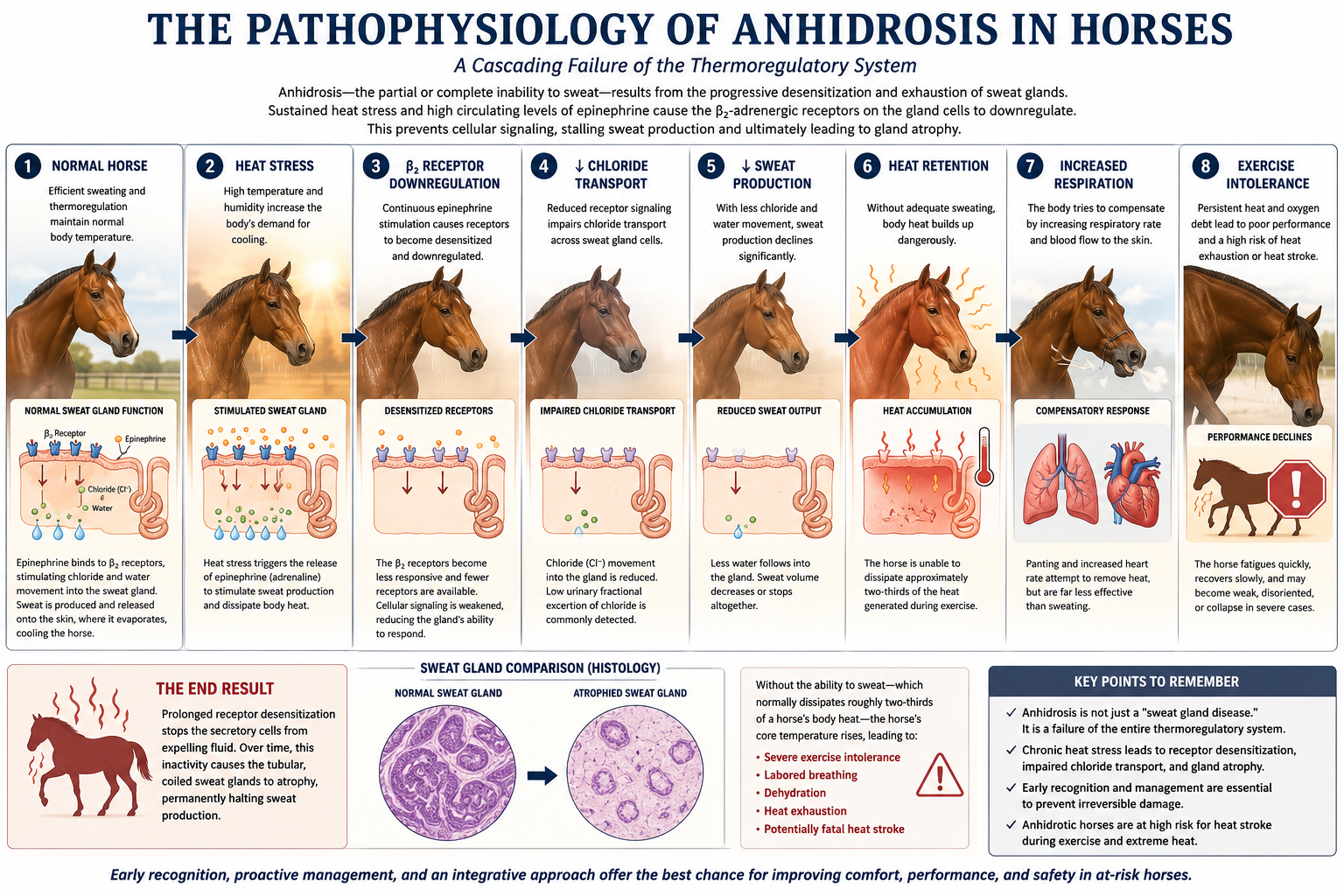
Although anhidrosis appears to be a disease of the sweat glands, it is more accurately described as a failure of the body's thermoregulatory system.
Under normal conditions, a horse's sweat glands are stimulated by the hormones epinephrine (adrenaline) and norepinephrine, which bind to specialized β₂-adrenergic receptors located on the surface of sweat gland cells. Activation of these receptors triggers a cascade of intracellular events that move electrolytes—primarily sodium and chloride—into the sweat glands. Water follows these electrolytes by osmosis, producing the large volumes of sweat necessary for evaporative cooling.
Florida's climate places extraordinary demands on this system. During months of prolonged heat and humidity, horses continually release epinephrine in an effort to stimulate sweat production. Over time, this constant stimulation begins to overwhelm the system.
β₂-Receptor Desensitization
Imagine repeatedly ringing the same doorbell all day long. Eventually, the person inside stops responding.
The same phenomenon occurs at the cellular level.
Chronic stimulation causes the β₂-adrenergic receptors to become progressively less responsive—a process known as receptor desensitization or downregulation.
As fewer receptors respond to epinephrine, the sweat glands receive a weaker signal to produce sweat.
Initially, horses may simply sweat less than expected. As receptor function continues to decline, some horses eventually stop sweating altogether despite obvious heat stress.
Impaired Chloride Transport
Producing sweat requires more than receptor activation. Electrolytes—particularly chloride and sodium—must move across the cells of the sweat gland to draw water into the sweat ducts.
Research has demonstrated abnormalities in chloride transport in horses with anhidrosis, including reduced fractional urinary excretion of chloride. Impaired electrolyte transport likely reduces the gland's ability to produce normal amounts of sweat.
Progressive Sweat Gland Dysfunction
As sweat glands receive less stimulation over time, they become progressively less functional. Histologic studies of horses with chronic anhidrosis have identified varying degrees of structural change and glandular atrophy.
Whether these changes are the primary cause of anhidrosis or develop as a consequence of prolonged inactivity remains an area of active research. Regardless, the end result is a vicious cycle in which reduced gland function leads to even less sweat production.
When the Cooling System Fails
When sweat production declines, body heat becomes trapped.
The horse attempts to compensate by breathing faster and redirecting blood flow toward the skin, but these mechanisms cannot match the efficiency of evaporative cooling.
The result is progressive heat accumulation, leading to:
Reduced or absent sweating
Excessive panting
Elevated heart rate
Delayed recovery after exercise
Exercise intolerance
Poor performance
Heat exhaustion
Heat stroke in severe cases
Think of the sweat glands like an air-conditioning system that has been forced to run continuously through a Florida summer. At first, it keeps the house cool. Eventually, however, the system becomes less efficient despite working harder than ever. Likewise, the horse's cooling system continues trying to respond, but the sweat glands no longer receive—or respond to—the signals necessary to produce adequate sweat.
Diagnosing Anhidrosis
There is no single blood test that confirms anhidrosis.
Diagnosis is based on history, physical examination, and ruling out other medical conditions that can produce similar signs.
Your veterinarian may recommend evaluating for:
Pituitary Pars Intermedia Dysfunction (PPID or Equine Cushing's disease), particularly in older horses
Equine Metabolic Syndrome
Electrolyte abnormalities
Dehydration
Respiratory disease
Cardiovascular disease
Musculoskeletal pain or lameness
A thorough examination ensures that any contributing medical conditions are identified and treated appropriately.
The Role of PPID and Insulin Dysregulation
Although Pituitary Pars Intermedia Dysfunction (PPID or Equine Cushing's disease) and Insulin Dysregulation (ID) are not considered direct causes of anhidrosis, both conditions can impair a horse's ability to cope with Florida's challenging summer climate and may contribute to exercise intolerance or abnormal thermoregulation.
PPID (Equine Cushing's Disease)
PPID is a common endocrine disorder in middle-aged and older horses. In addition to the classic signs of a long or delayed-shedding hair coat, muscle loss, and recurrent laminitis, horses with PPID may have difficulty dissipating body heat because they often retain a thicker hair coat, have altered metabolism, and may develop reduced athletic performance or generalized lethargy.
A horse with PPID may appear heat intolerant or slow to recover after exercise, making it important to distinguish these signs from true anhidrosis. Because PPID and anhidrosis can occur simultaneously, testing for PPID is often recommended in older horses showing decreased performance or difficulty handling the summer heat.
Insulin Dysregulation
Insulin dysregulation is characterized by an abnormal insulin response and is a hallmark of Equine Metabolic Syndrome. While it does not directly affect the sweat glands, chronic metabolic dysfunction can influence circulation, tissue health, body condition, and exercise tolerance.
Many horses with insulin dysregulation are overweight, have regional fat deposits, and are at increased risk of laminitis. These horses may fatigue more quickly during exercise and appear less tolerant of heat, even though their sweat glands are functioning normally.
Why It Matters
Because PPID, insulin dysregulation, and anhidrosis can produce overlapping clinical signs—such as poor performance, exercise intolerance, prolonged recovery, and heat sensitivity—a complete veterinary evaluation is essential. Identifying and treating underlying endocrine disease not only improves your horse's overall health but also helps ensure that anhidrosis is managed as effectively as possible.
For many horses, the best outcomes come from treating the whole patient. Addressing endocrine health, nutrition, body condition, environmental management, and thermoregulation together allows us to develop a more comprehensive and individualized treatment plan.Conventional Management
Treating Anhidrosis
Unfortunately, there is no medication that consistently restores sweating in every horse.
Instead, successful management relies on reducing heat stress while supporting the horse's ability to regulate body temperature.
Treatment may include:
Riding during the coolest parts of the day
Maximizing shade and ventilation
Using fans
Maintaining hydration and electrolyte balance
Strategic conditioning
Nutritional support
Many owners also utilize supplements such as One AC®, Sweat More®, or similar products. Although scientific evidence remains limited, some horses appear to benefit, and these supplements may be useful as part of a comprehensive management plan.
Another long-standing anecdotal therapy is dark beer, particularly beers containing hops. While controlled research has not consistently demonstrated effectiveness, many owners have reported improvement in individual horses. Responses vary considerably, and these therapies should be viewed as supportive rather than curative.
One recommendation that has changed significantly over the years is cooling therapy. Research now shows that continuous application of cool water, especially when combined with fans or airflow, is one of the fastest and safest methods for lowering a horse's core body temperature. Contrary to an old myth, cool water does not trap heat.
Looking Beyond the Sweat Glands
Conventional medicine explains how anhidrosis develops through receptor desensitization, altered electrolyte transport, and progressive sweat gland dysfunction.
Traditional Chinese Veterinary Medicine asks a complementary question:
Why has the body's ability to regulate heat become compromised?
Rather than focusing solely on the sweat glands, TCVM evaluates the entire physiologic system responsible for thermoregulation, fluid metabolism, adaptation to environmental stress, and overall health.
These two approaches are not contradictory—they simply examine the same patient through different lenses. Conventional medicine helps us understand the mechanisms of disease, while TCVM provides an additional framework for identifying patterns of imbalance and restoring physiologic function.
Understanding Anhidrosis Through a TCVM Lens
In Traditional Chinese Veterinary Medicine, anhidrosis is rarely viewed as a disease of the sweat glands alone. Instead, it is considered a manifestation of an underlying imbalance affecting the body's ability to regulate Heat, fluids, and Wei Qi.
One of the easiest ways to understand Yin is to think of it as the body's natural cooling and moisturizing system—essentially the horse's internal air conditioner.
Florida horses spend months exposed to intense heat and humidity. Over time, that constant environmental Heat places tremendous demands on the body's cooling mechanisms. In TCVM, prolonged exposure to Heat and Damp-Heat gradually consumes Qi, Yin, and body fluids.
As Yin becomes depleted, the horse becomes progressively hotter, drier, and less capable of cooling itself.
The goal of acupuncture and Chinese herbal medicine is therefore not simply to make a horse sweat. Instead, treatment focuses on restoring physiologic balance, nourishing Yin, supporting normal fluid metabolism, regulating the movement of Wei Qi (the bodies protective or defensive energy that is regulated by the Lung), and helping the body regain its natural ability to regulate temperature.
Common TCVM patterns include:
Lung Qi Deficiency
Lung Yin Deficiency
Kidney Yin Deficiency
Qi and Yin Deficiency
Internal Heat
Triple Heater (San Jiao) dysfunction
Because every horse is different, treatment is individualized according to the horse's underlying pattern rather than the diagnosis of anhidrosis alone.
How Is a TCVM Pattern Diagnosed?
Unlike conventional medicine, which diagnoses a disease, Traditional Chinese Veterinary Medicine (TCVM) identifies the underlying pattern of imbalance contributing to the disease process. During a TCVM examination, we evaluate far more than the horse's inability to sweat. A complete assessment includes the horse's medical history, temperament, environment, diet, exercise level, response to Florida's heat and humidity, tongue characteristics, pulse quality, and findings from a detailed acupuncture point palpation examination (APSP). By combining these observations, we identify the pattern—or combination of patterns—that best explains the horse's clinical signs. This individualized approach allows acupuncture points and Chinese herbal formulas to be tailored specifically to each horse, which is why two horses with anhidrosis may receive very different treatment plans despite sharing the same diagnosis.
Why Acupuncture & Chinese Herbal Medicine May Help
From a TCVM perspective, acupuncture works by restoring balance within the body's regulatory systems rather than simply stimulating sweat production.
Treatment may help:
Support Lung function
Nourish Yin
Tonify Qi
Clear Internal Heat
Improve fluid metabolism
Regulate the Triple Heater
Promote normal thermoregulation
Florida Summer Heat Safety Checklist
Managing Florida's climate is just as important as treating anhidrosis itself.
✅ Monitor the Heat Index—not just the temperature.
Humidity dramatically reduces evaporative cooling. A heat index above 100°F warrants reducing or modifying exercise, while values above 105°F should prompt postponement of strenuous work whenever possible.
✅ Ride early.
Schedule exercise during the coolest hours of the morning whenever possible, and avoid peak afternoon heat.
✅ Keep fresh water available at all times.
Never restrict water after exercise. Horses recover more effectively when they have free access to clean water.
✅ Replace electrolytes appropriately.
Working horses lose large amounts of sodium, chloride, potassium, calcium, and magnesium through sweat. Supplement electrolytes according to workload and always provide free-choice water.
✅ Cool early and cool aggressively.
Continuously hose the horse with cool water and use fans to enhance evaporation. Don't wait until the horse is severely overheated before beginning active cooling.
✅ Provide shade and airflow.
Shade, well-ventilated barns, and fans significantly improve a horse's ability to dissipate heat.
✅ Monitor recovery.
A horse's breathing and heart rate should steadily improve after exercise. Persistent panting, elevated heart rate, or failure to recover normally should never be ignored.
✅ Recognize early warning signs.
Sweating less than stablemates, taking longer to recover, seeking shade excessively, or showing declining performance may all be early signs of anhidrosis.
✅ Know when to call your veterinarian.
Contact your veterinarian promptly if your horse stops sweating, develops a rectal temperature above 103°F that does not improve quickly with cooling, remains tachypneic (increase work of breathing) after exercise, appears weak or depressed, or shows signs consistent with heat exhaustion or heat stroke.
Our Integrative Approach
Every horse is unique, and successful management begins by treating the whole horse—not just the sweat glands. At Fauna Doc Integrative Veterinary Services, every horse receives a comprehensive evaluation that considers conventional diagnostics, nutrition, endocrine health, workload, musculoskeletal function, environmental management, and TCVM pattern diagnosis.
Treatment recommendations are individualized and may include acupuncture, Chinese herbal medicine, nutritional support, electrolyte recommendations, cooling strategies, exercise modification, and diagnostic testing when appropriate.
Our goal is not simply to restore sweating—it is to improve thermoregulation, comfort, recovery, performance, and overall quality of life.
